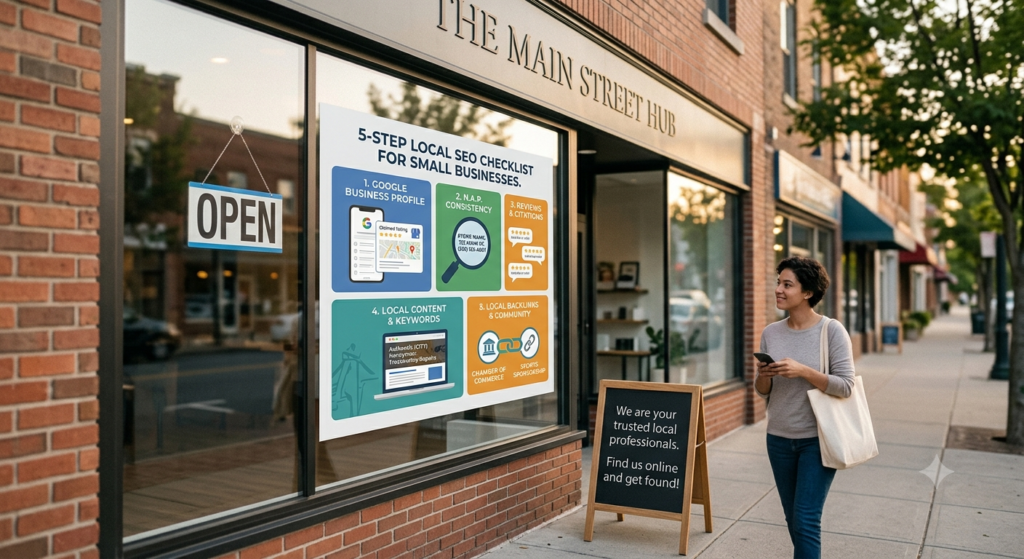
Step 1: Claim and Maximize Your Google Business Profile (GBP)
Your GBP is the single most important factor for local ranking success. Think of it as your digital storefront.
- Claim & Verify: Provide a direct link or walkthrough on how to officially claim the listing.
- Accuracy is Key: Complete every single field—exact business name, category, phone number, attributes, and operating hours.
- Visual Trust: Add high-quality photos of the business interior, exterior, and team. Businesses with photos receive 35% more clicks.
Step 2: Lock Down NAP Consistency (Name, Address, Phone)
Google needs to trust that your business data is accurate before it confidently recommends you to searchers.
- The Golden Rule: Your Name, Address, and Phone number must be identical everywhere they appear online.
- Standardize Formats: If you use “Suite 100” on your website, don’t use “#100” on Yelp or “Ste. 100” on Facebook. Pick one format and stick to it.
- Audit Directory Citations: Clean up listings on major directories like Yelp, YellowPages, Apple Maps, and Bing Places.
Step 3: Build a Review Generation System
Reviews are a major ranking factor because they prove to Google—and potential customers—that you are a legitimate, high-quality business.
- Ask Directly: Train staff to ask happy clients for feedback, or set up automated post-purchase emails.
- Simplify the Process: Shorten the user journey by sending direct links to your GBP review form rather than asking clients to find it themselves.
- Always Respond: Reply to every review professionally—both positive and negative. It signals an active, customer-focused business.
Step 4: Optimize On-Page Content for Local Keywords
Your actual website still needs to communicate geographic relevance to search engine crawlers.
- Localize Titles & Meta Tags: Include your city or neighborhood name in your primary page titles, headers ($H1$, $H2$), and meta descriptions (e.g., “Best Handyman in Austin, TX”).
- Embed a Google Map: Place a live Google Map on your Contact page to visually anchor your location.
- Create Localized Content: Write blog posts about community events, local partnerships, or specific case studies unique to your target areas.
Step 5: Earn Local Backlinks
A backlink is a vote of confidence from another website. Getting links from local organizations signals to search engines that you are deeply embedded in the community.
- Sponsorships & Charity: Sponsor local sports teams, charity events, or community festivals that feature a “sponsors” page with outbound links.
- Local Chambers: Join your town’s Chamber of Commerce or local business associations to secure high-authority directory links.
- Vendor Relationships: Ask local partners, suppliers, or wholesale clients if they will feature your business on a “where to buy” or partner page.